China Travel Blog: The Black Traveler

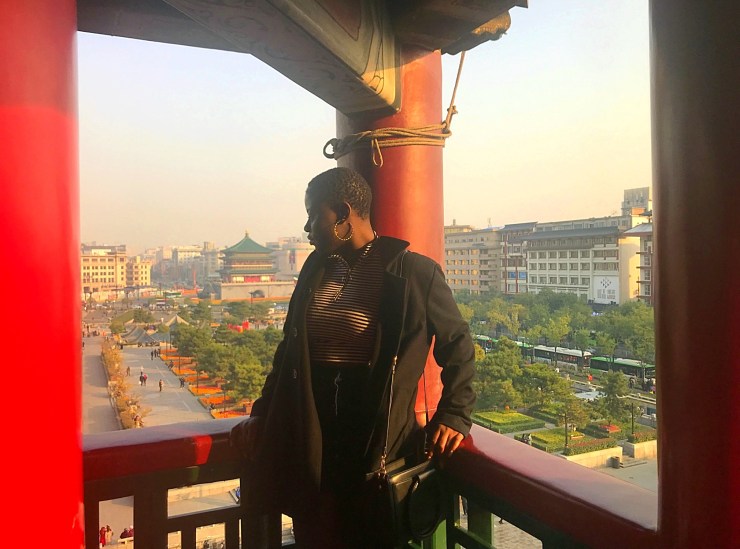
During my lifetime (so far and I pray in the future) I have been blessed with the opportunities to travel to different cities and countries. My parents say I have a itch and can’t stay in one place. They’re right. Nonetheless in all the places I traveled I never thought about traveling as a person of color until my recent trip to China. All the previous places I’ve traveled to, have been exposed to and have people with a dark skin tone like myself within their communities. However in China, I realized that not every community has had interactions with black people before, if ever. Many times, I was stopped by people to take pictures with them, pointed at, stared at, touched (sometimes without permission), sometimes even followed. Some interactions were pleasant, others not so much. My other white companions did not receive the same treatment, not at the obsessive level I and other black visitors experienced. It made me realize that my black skin signifies something around the world. I may not have realized it before but there will be places where I travel to where my presence will generate a reaction. I will never be just another tourist visiting a place. My presence will be questioned, will marvel people, will turn some off, will be noticed… I can’t be invisible. In China when incidents like this would happen, I didn’t know what to make of them (I did get upset when one woman grabbed me without my permission and kept following me) but I was not annoyed by the incidents. I was mostly concerned about the ignorance and lack of exposure to black representation, knowledge, or people. I didn’t blame the individuals, I didn’t know who was at fault but it made me realized that there’s a different kind of wonder, or maybe prejudice surrounding my blackness. I mean black skin is beautiful, full of melanin and brightness I would want to (at a respectable distance) admire it too…

Regardless it does make me wonder what other places will I travel to that have never been exposed to black people? Will this ignorance/lack of knowledge lead to discriminatory actions? Unfortunately it wouldn’t surprise me if the answer is yes.

Reproductive Justice for All

I haven’t had health insurance for over two years now, however living in a first world country I am aware that worse come for worse I can find the adequate resources to address my reproductive health. That is not possible for many women around the globe. In many developing countries there is a severe lack of resources dedicated to health care, particularly reproductive health. Twenty years ago my mother gave birth to me on blanket on a floor in one of the most stable hospitals in our homeland Ghana. Twenty years later there is still an enormous lack of resources in developing countries and the situation is not improving for women around the globe. Policies imposed by the United States has impact on the lives of thousands of marginalized communities worldwide.

The Trump Administration has extended the Global GAG Rule (AKA Mexico City Policy) towards all global health. This policy prohibits all institutions abroad receiving US funds from mentioning, discussing, referring to abortions in any means, otherwise they will lose their funding. Due to this unethical principle many health organizations, such as Family Health Options in Kenya, are losing funding used not only to address family planning and reproductive health but also to support other health services (child nutrition, vaccinations, educational health programs, and others).

For clarification the US has never funded abortions anywhere, therefore the Global GAG rule actually hurts healthcare services and women’s access to health in many various ways that make one understand that this is more an attack to eradicate women’s empowerment and rights. As  one of the attendees at the Population Connection Action Fund conference stated, the United States is a global forefront for freedom of speech and by imposing this rule it limits freedom of speech in health facilities and impedes doctors from informing and giving patients the best options (whether including abortion or not) available to them.

The Trump Administration has made it its’ personal goal to eradicate the development of reproductive health and rights globally. Domestically these bullshit policies would not be supported, therefore the administration is attacking women’s health in developing countries by cutting funding from programs supporting family planning services.

Using ridiculous reasoning, and absolutely fake news, the US has withdrawn funding from the UNFPA (United Nations Population Fund) which is an organization that works in Member States of the UN to provide health services to sustain women’s health care. UNFPA does not administer abortions, and mainly aims to provide resources and services to ensure that “every pregnancy is wanted, every birth is safe, every young person is free of HIV/AIDs, and every girl and woman is treated equally.” The mission of UNFPA and that of many family planning organizations is to promote reproductive health and rights for all,  which is a basic human right that all individuals have. The US defunding such programs is not only promoting unwanted pregnancies, unsafe abortions as well as STDs but is also in violation of basic human rights.

I urge you all to please stand with me, stand with Population Connection Action Fund, UNFPA, other health organizations and women across the globe to fight for human & reproductive health rights, fight for health empowerment and rights, to fight for HER.

Spread this message through your social media, and educate yourself on reproductive freedom and rights, and contact your representatives to support the Global HER Act (bill proposed opposing the Global GAG Rule). Text FIGHT to 52886 to learn more.

“Is That Your Real Hair?”

The other day my friend and I were standing in Walmart, talking, waiting for our uber to arrive and a caucasian lady walked up to her touched her braids and asked her whether that was her real hair. During the conversation, she continued to pet her hair, then complimented it and walked away.

I asked my friend: could you imagine walking up to a white girl, petting her hair and asking whether her hair was real? At that point we just looked at each other and laughed. Because no, we could never imagine doing that, but these incidents occur regularly in our lives.

Why?

Well there’s uneducated ignorance where others do not know much about black culture due to various reasons that are both within and outside their control. First stereotypes play a huge role in these instances. “All black girls wear weave.” Correction: everyone regardless of background wears weave, as we can see with our lovely Kardashian family. And here’s a secret: extensions are a just a fancier term for weave.

People choose to believe these stereotypes and proceed to making assumptions which leads to accidents where instead of one just complimenting the hair, proceed to ask whether the hair is real or not.

It is understandable that there is a difficulty in knowing because Hair is a big part of black culture and there are different hairstyles that have a very deep cultural significance and are part of the identity as a black girl. Culture is not the only factor that goes into wearing braids, cornrows, twists etc.., it is affected also by weather, habits, and the way our hair is naturally built.

Whether the hair is real or not, hair is part of how we express ourself, our emotions, our feelings. Personally I have the habit of changing my hair frequently because the way I wear my hair is affected by the way I’m feeling. There are periods when I’m feeling my afro and I rock that, days where I feel like having long lucious bouncy hair so I rock my weave, and I do get moods where I really want to wear braids so I do. The way we choose to wear our hair is affected by culture, habits, seasons, and how significant they are to us.

The way we wear our hair also aims to defy social norms, where people in general view black hair as non professional, not beautiful, and  exotic but not right. Day by day black women have been conquering those negative social views surrounding black hair, especially with the intention of inspiring younger generations to believe that their hair is beautiful too! I can see that with my younger sister, where while my experience as young black girl was to shy away from my hair and my braids, through my learning, appreciation and pride in black hair and culture, she has this immense confidence and love for her hair, natural or not.

Our hair is beautiful, it is a part of our culture, our identity. It is a great thing that other cultures can love and learn about too. But it is important to understand that there is a right way to show appreciation and to ask questions when it comes to learning about black or any other culture. Making assumptions, stereotypes, and appropriating our culture are not the right ways. And most importantly, do not touch our hair.

You Speaking White

My friends of color often laugh at me when they hear me talking to my white friends because I speak differently. I do.

This is not news to me, because ever since I moved to this country I have been told “You speak like a white person”. It did take me a while to understand what that meant, because coming from Italy, where MOST, of my friends were white, I talked like everyone else around me.

However, when I moved to the US, to Newark, a predominantly black community, I came upon the realization that I did speak differently. The combination of a very thick accent, learning new slang, and speaking “dictionary english”, and I guess just my tone, made me sound differently than my classmates, but I never thought of it as speaking “white”.

As time went on, understanding the system and racial issues of this country made me realize that I do speak differently. Differently in the sense that the way speak tends to be associated with a certain race.  There is not necessarily a good way of speaking, because as Jay-Z said “intelligence is not attributed to color”, but there are different perceptions of a person’s tone and choice of words that are attributed to certain groups of people. People are and judged treated differently based on the notion of whether they sound white or black. Several people I know put on their “white voices” when speaking on the phone, because you are more likely to get listened to if you sound white. People respect you more when you speak “white”. I could never and still can’t believe this is a reality. It baffles me how oppressive this is. The implicit meaning of how “white” equals more intelligent, worthy of your attention.

Personally I have tried speaking more of what is considered as a “black person” because I wanted to feel part of my people and did not want it to seem like I was agreeing with problematic views. I was told that I didn’t sound right and that’s right because I just sound like me, accent and all. Yet, over the years, I guess unconsciously I have assimilated to speaking differently depending on the type of people I am surrounded by. Even though I am aware of this, I do not even realize that I am doing so, until it’s pointed out to me. This behavior has become natural to me, and I wonder why? Is it to fit in? To feel more included or accepted within the race I am surrounded by? Is it just a behavior which I have learned to better adapt?

To be honest, this entire notion of a way of speech being associated to a race is ridiculous to me, however I do recognize that it is real social matter.